Spoiler alert: Contains info about winner the of
The Bachelorette.
(And yes, it does have to do with filing.)
A subtitle had to be included on this post because, let's face it: filing? So. Not. Sexy. But, it'll make your life a bit easier!
For this week's William Morris post, I was planning something a little more glamorous (if you can call sorting through my dresser glamorous) but frankly, I wanted a project I could complete while watching the season finale of
The Bachelorette (soooooo glad she picked Jef, BTW, even though he's missing an 'f' from his name). (I love me some bad TV, especially when certain computer programing languages are causing me all sorts of want-to-throw-computer-equipment-out-of-the-window type feelings.) This left me with the filing cabinet.
Another reason to tackle the files, is that I recently read a chapter or two out of the book
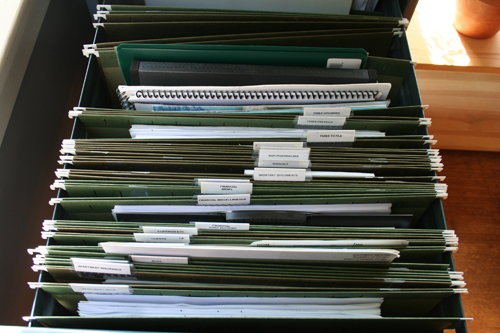
Getting Things Done, which takes a very early 2000s, let's work ourselves to death approach to life, but is none the less super helpful when it comes to organizing one's files. In the book, David Allen says that if the systems in your life aren't super easy to use, you won't use them. (Why didn't I think of that? I could be a millionaire book author by now ... but I digress.) This made a lot of sense to me so I followed his advice and organized my files in a way that makes them easy to use. That meant that I got rid of the actual files and put all of my papers and crap straight into the hanging files that came with our second-hand filing cabinet. That way, I can actually see what's in a file and move it around with no interference. Easy-peasy, right?
I also labelled all of them
with a label maker, something Allen also advises, though let's get real, besides loving crap television, I also love any excuse to use something as type-A as a label maker. Also on the David Allen list o' wisdom, was to organize my files alphabetically. My inner librarian sort of cringed at not using some sort of Dewey decimal or similarly categorized system, but hey, who's going to knock best-selling organizational wisdom? When all was said and done, I was really pleased with how it all turned out. I know where everything is now and I don't have to remember whatever system I put in place several months ago, every time I want to figure out if the phone company is trying to screw me or not (which they usually are).

There was another piece of David Allen wisdom I took, which has proven to be pretty golden. I tend to worry about things that I can't deal with right away. You know: things like having to wait for some form to arrive by snail mail before I can actually apply for the right health coverage etc. It's silly, I know, and the obvious solution is therapy or some kind of zen living in the moment thing. However, I feel like I've solved this worry-wort problem by employing what David Allen calls the ... well, I can't remember ... but the long and short of it is, have a folder (and a corresponding to-do list, but that's another post) that contains all of the 'Waiting for ..." items. The stuff you can't do anything about until so-and-so gets such-and-such to you or what have you. This has helped me feel less stress because all of that stuff is somewhere handy, waiting for me to do what I need to do with it when the time comes. I'm keeping that file, as well as a few other frequently used ones (not the phone bills, but the file for receipts that will turn into tax deductions and the like) close at hand, in a little pouch tacked to the wall above my desk. Handy and dandy.

Now, you might be thinking that I am totally compulsive and a little obsessive, and I am but, my friends, I do all of this because I know who I am and I know that if I can just get stuff out of my head and into my files (where I don't have to think about it) it leaves me much more time and mind space to be spontaneous, have more fun and even be more productive. So there you have it, complete with some rhymes. I think William Morris might approve.
P.S. If you're considering reading
Getting Things Done because of this post, I apologize. Depending on what type of person you are, reading it before bed can either be good (it'll put you to sleep before you can say 'filing cabinet') or, bad (if you're like me, you'll stay up half the night thinking about how much better your life will be once your files are organized). Don't say I didn't warn you.
This post is part of the
William Morris Project. I'll be linking this post to the inspiration:
Pancakes and French Fries.